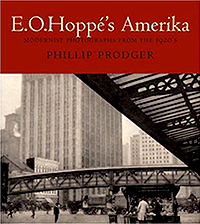
Cloth, 160pp,
9"x10"
W.W. Norton, New York, April 2007

Cloth, 160pp,
9"x10"
W.W. Norton, New York, April 2007
E.O. Hoppé's Amerika
Book Release and New York Exhibition
Hoppé's Amerika photographs shown in New York for the first time in over eighty years, accompanied by the release of a publication of a 160-page monograph.
On 13th April 2007 the exhibition Hoppé’s Amerika opened at New York’s Silverstein Photography gallery accompanied by the publication of a 160-page monograph of the same title by W. W. Norton with an insightful essay by Philip Prodger. This was be the first US showing of Hoppé’s American photographs in over 80 years demonstrating to an American audience his awareness and command of early photo-modernist lexicon that made him then and now formidable competition to his American contemporaries.
"To the victor go the spoils, and in the case of art the victor is the one who makes his or her way into the history books. The process by which this happens is comples, unpredictable, and can be unfair. Over time, decisions made by historians become self-perpetuating, because young photographers learn of their predecessors' works through exhibitions, books, and catalogues. The birth of modernism in photography is currently ascribed to an iconic group of artists that rightly includes Stieglitz and his collegues. Ironically, as the photographs in this book reveal, the wonderful inventiveness of their photography was anticipated and in some cases possibly inspired by a figure whose name has now fallen partially into obscurity. Hoppé deserves better. As he eloquently put it, "It comes just to this, that whatever we intensely feel and love will reveal to us its inner powers in a way that can never be obtained by the one who treats his medium as merely the mechanism of expression. The camera is, in itself, of course, purely mechanical, but it can be made the vehicle for the revelation of true art, according to the one who manipulates it."
—Philip Prodger, from his introduction to the book
Background on E.O. Hoppé
German-born British photographer Emil Otto Hoppé (1878-1972) was the most celebrated portrait and topographic photographer of the Modern era. Contemporaneous with Edward Steichen, Alfred Stieglitz, and Walker Evans, Hoppé was described by British photographer Cecil Beaton simply as “The Master.” His now rare photographic books from the 1920s and 30s on America, Great Britain, and Germany—classics in photographic literature—show Hoppé’s pioneering Modernist style that was largely formative and influential in the practice of photographic art in the first half of the twentieth century.
Hoppé studied portrait photography in Paris and Vienna before moving to live in London in 1900. In 1907, after winning first prize in a contest sponsored by the London newspaper the Daily Mail, Hoppé left banking to open a portrait studio in London’s Baron’s Court. His photographs of arts celebrities such as Thomas Hardy, George Bernard Shaw, A.A. Milne, T.S. Eliot, G.K. Chesterton, Leon Bakst, Vaslav Nijinsky and the dancers of the Ballets Russes quickly earned him the reputation as the top celebrity photographer in London. His passion for street photography and his pioneering efforts in photographic art, along with his naturalistic studies, were widely celebrated in the US, Britain, and Europe. In 1913 he expanded his studio to the Kensington house of the late painter Sir John Millias, occupying all thirty-three rooms with his burgeoning operation.
By 1919 Hoppé tired of his work and sought travel to foreign countries to photograph self-assigned subjects. His large-format gravure-printed photographic books about “Fair Women” (1922), Great Britain (1926), the United States (1927), Germany (1930 and 1932), Australia (1931), and India (1935) were likely to have influenced his contemporaries.