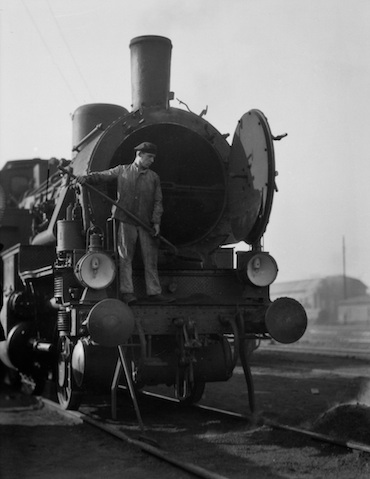
E.O. Hoppé:
Shoveling Coal into Locomotive, Anhalter Bahnhof, Berlin, 1925
E.O. Hoppé Estate Collection Newsletter | September 2010

Hoppé Exhibition in Berlin:
Menschen, Dinge, Menschenwerk, 1925-1929
Curated by Thomas Friedrich, Phillip Prodger and Manfred Heiting
Organized by Kulturprojekte Berlin GmbH at the Berlinische Galerie, Berlin
October 14, 2010 through February 28, 2011
German-born Emil Otto Hoppé (1878-1972), best known as one of Britain’s pre-eminent portrait photographers, began in 1920 to travel extensively throughout the world, exploring the people and places of the US, Britain, Europe, Australia, India, and other locations. The pictures he made on these journeys became the subject of the numerous pioneering photobooks that were published in the 1920s and 1930s.
Between 1925 and 1938 Hoppé took frequent trips to Germany. The images he made there are among the most powerful industrial photographs ever made. Deeply affected by the country’s industrial buildup, he created a body of work with unprecedented psychological charge, examining the country’s burgeoning manufacturing base and the people who shaped it. Ever mindful of the militarism inherent in the enterprise, and impressed by the sociological implications of working in mechanized landscapes, these pictures formed the basis of Hoppé’s widely acknowledged masterpiece Deutsche Arbeit (1930). The work conveys a broad, philosophical discomfort with the relationship between man and machine.
Among the magnificent views of Berlin in the mid-1920s, we also see portraits and behind the scenes photographs from the UFA film studio in Berlin during its heyday in the late 1920s. The subjects Hoppé photographed at the studio include many icons of the silent era including Camilla Horne, Lil Dagover, and Anna May Wong.
Though he corresponded extensively with the great German modernist Albert Renger-Patsch, and anticipated the work of August Sander in his photographs of human types, Hoppé’s influence is rarely acknowledged in contemporary art history. Yet he pushed the boundaries of conventional modernism, introducing for the first time elements of typology, seriality, and sequence that would come to dominate photographic practice. With his German photographs, Hoppé is revealed as a pivotal figure in the history of twentieth-century photography.
Menschen, Dinge, Menschenwerk, 1925-1929 is on exhbition October 14, 2010 through February 28, 2011 at the Berlinische Galerie, Berlin.
Forthcoming Titles (2012–2013):
E.O. Hoppé: Nudes, 1909–1936 (Curatorial Assistance, 2012)
One Hundred Photographs: E.O. Hoppé and the Ballets Russes (Curatorial Assistance, 2012)
E.O. Hoppé: The German Work, Photographs 1925–1938 (Steidl, 2012)
E.O. Hoppé: Indian Subcontinent of the Cusp of Change (2012)
E.O. Hoppé: The British Machine, Photographs of Industrial Britain Between the Wars (2013)
Current Titles:
Hoppé Portraits: Society, Studio, and Street, Photographs 1909–1945 (National Portrait Gallery, 2011)
E.O. Hoppé’s Bombay: Photographs from 1929 (Marg Publications, 2010)
E.O. Hoppé’s Santiniketan: Photographs from 1929 (Marg Foundation, 2010)
E.O. Hoppé’s Amerika: Modernist Photographs from the 1920s (W.W. Norton, 2007)
E.O. Hoppé’s Australia (W.W. Norton, 2007)
Hoppé’s London (Guiding Light, London, August 2006)
©2010 The E.O. Hoppé Estate Collection | c/o Curatorial Assistance, Inc.
113 East Union Street • Pasadena California 91103 USA • 626 577 9696
www.eohoppe.com | info@eohoppe.com
113 East Union Street • Pasadena California 91103 USA • 626 577 9696
www.eohoppe.com | info@eohoppe.com